Norvic Philatelics - GB New
Stamps and Special Postmarks
Action for Species 4:
Endangered Mammals
- 13 April 2010 & Retail booklet 15 June 2010
The fourth in Royal Mail's new
nature series, 'Action for Species' concentrates on mammals. The series
examines UK species that are endangered, but thanks to the efforts of
conservation groups and the public, we have become increasingly aware
of the threats to our mammal populations, and many now benefit from
legal protection and active conservation measures, and are showing
encouraging signs of recovery.
The
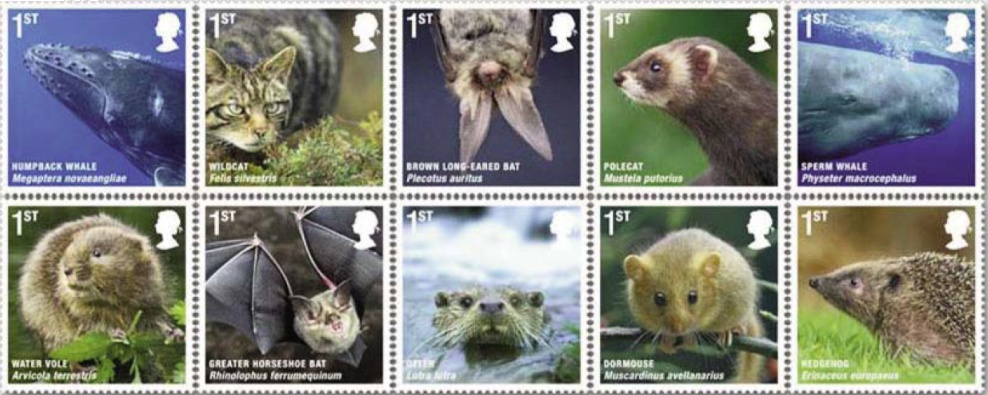
issue comprises of ten 1st class stamps in a se-tenant block featuring
UK insect species that are endangered. The British Isles is home to
more than 60 species of mammals, but almost half of these have been
introduced from elsewhere in the world – and they include
some of the most abundant, like the rabbit and grey squirrel.
All ten mammals are the subject
of conservation programmes due to the effect of adverse changes in
their environment caused by pollution, the growth in roads and housing
developments, and in some cases the introduction of non-native species,
which have all contributed to a fall in numbers.
Each stamp features a photograph of the insect together with its common
and scientific name.
2010 is also the International
Year of Biodiversity.
COPYRIGHT MATTERS
All images are copyright Royal
Mail.
Wildlife Trusts and others wishing to use images on websites or in
magazines should contact Royal
Mail's Intellectual Property Department.
|

|
|
|
1. Humpback Whale
|
2. Wildcat<
|
3. Brown Long-Eared
Bat
|
4. Polecat
|
5. Sperm Whale
|
|
6. Water Vole
|
7. Greater
Horseshoe Bat
|
8. Otter
|
9. Dormouse
|
10. Hedgehog>
|
|
The mammals in detail
Humpback Whale – Megaptera
novaeangliae
(Average weight: 45 tonnes,
total length: 13–15m)
This big, black whale with white
under its tail has knobbly flippers that are longer than those of any
other whale. Seen mainly in summer to the west of Britain, it arches
its back to dive and feeds by sieving small fish from the water using a
complex array of frilly plates found in its upper jaw instead of teeth.
Wildcat
– Felis silvestris (Average
weight: 5.5–6.5kg, total length: 75–110cm)
Shy and nocturnal, and now confined to the wilder parts of Scotland,
the wildcat resembles a tabby cat with prominent black stripes on the
body and legs. Its tail is thick and round-ended compared to the
domestic cat’s thin, pointed tail, but there are many
hybrids. Female wildcats can produce one family a year, in spring.
Brown
Long-eared Bat – Plecotus
auritus (Average
weight: 6–10g, total wingspan: 26–29cm)
A small fluttery bat with enormous ears, this mammal is found
throughout mainland Britain, except for the extreme north of Scotland.
It commonly occurs in attics, as well as hollow trees and bird boxes,
and often hovers to pick insects and spiders off trees. Completely
harmless and a gentle creature, this is the bat most often found flying
inside houses.
Polecat - Mustela putorius
(Weight between 0.7 kg for females to 1.7 kg for males)
The European Polecat (Mustela putorius), also known as a fitch,
foumart, or foulmart, is a member of the Mustelidae family,
and
is related to the stoats, otters, weasels and minks. Polecats are dark
brown with a lighter bandit-like mask across the face, pale yellow
underbody fur, a long tail and short legs. They are somewhat larger
than weasels but smaller than otters. The European Polecat is the wild
ancestor of the domesticated ferret. (Source: wikipedia)
Sperm Whale – Physeter
macrocephalus (Average
weight: 15–40 tonnes, total length: 10–15m)
The sperm whale, with its huge, blunt-ended head, is normally found in
deep waters to the west of Britain, but occasionally strays into
estuaries and gets stranded when the tide goes out. Usually solitary,
the sperm whale sometimes lives in small groups. After swimming at the
surface for about 10 minutes, it then dives deep for half an hour to
feed, mainly on squid.
Water
Vole – Arvicola terrestris (Average
weight: 180–230g, total length: 29–31cm)
A rat-sized animal with a chubby face and dark chocolate-brown fur, the
water vole is a good swimmer and lives beside ponds, rivers and
ditches, where it digs burrows in the banks and feeds on juicy
vegetation, roots and bark. It is found mainly in the lowlands,
throughout mainland Britain, usually in small colonies.
Greater Horseshoe Bat – Rhinolophus
ferrumequinum
(Average weight:
15–30g, total wingspan: 33–39cm)
Large and broad-winged, this species of bat has a distinctive
cone-shaped nose-leaf through which its echolocation sounds are
focused. Its wings and ears are pale brown, and the fur is grey or
buff, with a reddish tinge in older animals. Found mainly in south-west
England and south Wales, it hibernates in caves, cellars and mines from
October to May, wrapping its wings around its body while roosting. Its
food consists of beetles and other large-bodied insects, caught in
flight or snatched from the ground. In summer, females seek out warm
places such as barn roofs, where, after a 75-day gestation period, they
give birth to a single baby each year, nearly a third of its
mother’s weight.
Otter
– Lutra lutra
(Average weight:
6–8kg, total length: 100–110cm)
Large, long and sleek with short legs and webbed feet, the otter is
normally seen only in or beside water, where it swims and dives
frequently in pursuit of fish, crabs and other aquatic food. More
widespread and numerous in western counties, many live along the shores
of Scotland’s sea lochs. Otters will usually live alone or in
a family group of a female and one to three young.
Dormouse
– Muscardinus avellanarius (Average
weight: 10–30g, average body length: 12–15cm)
This golden-yellow mammal is the only British mouse with a thick fluffy
tail. Found mostly in southern England, it is usually nocturnal and
hibernates over the winter. Active among the branches of shrubs and
trees, it feeds on flowers, fruits and insects.
Hedgehog – Erinaceus europaeus
(Average
weight: 500–1200g, total length: 20–25cm)
Britain’s only spiny mammal is found throughout the UK.
Normally nocturnal, it snuffles about in gardens, farmland and
woodland, feeding on worms, beetles and other small prey. It rolls into
a tight ball when alarmed, and hibernates for five to six months over
winter.
Technical
details: The 35mm square stamps
are designed by Jason Godfrey. Photographic credits: humpback
whale © Brandon Cole/Nature Picture Library; wildcat
© Peter Cairns/Nature Picture Library; brown long-eared bat
© Les Stocker/Photolibrary Group Ltd; polecat
© Paul Hobson/Royal Mail; sperm whale © Thomas
Haider/Photolibrary Group Ltd; water vole © Terry Whittaker;
greater horseshoe bat © Biosphoto/Frank &
Philippe/Still Pictures; otter © Paul Hobson; dormouse
© Stephen Dalton/NHPA/Photoshot; hedgehog © Laurie
Campbell/Royal Mail
In sheets of 30/60 they are
printed in lithography by Cartor Security Printing, perf
14½.
The stamp and postmark images
are Copyright 2010 by Royal Mail.
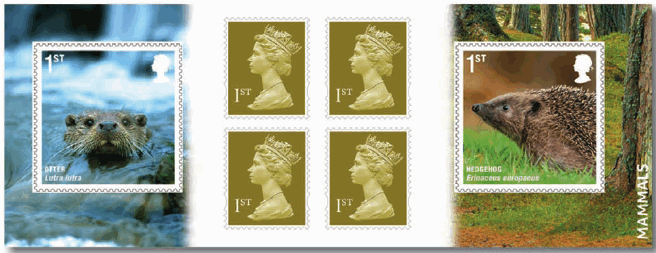
Retail booklet - 15 June
A retail booklet of 6 self-adhesive stamps, being 4 x 1st class gold
Machin definitives and Otter and Hedgehog mammals stamps - for first
day postmarks see the retail
booklets page.
Special
Postmarks
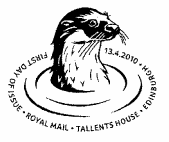
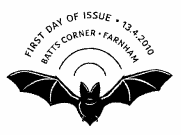
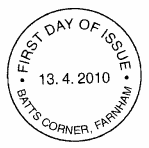
Postmarks available for the day of issue will be shown below here
these may not be to scale. These
postmarks cannot be obtained to order after 13 April.
|
|
|
|
|
Ref FD1019
Official Philatelic Bureau FDI. |
Ref FD1020
Official Batts Corner FDI postmark. |
Ref FD1020NP
Official Batts Corner non-pictorial FDI postmark |
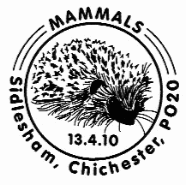
Ref L11692
Sidlesham, Chichester (Hampshire) |
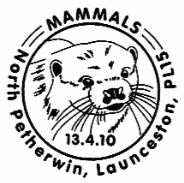
Ref W11703
North Petherwin, Launceston (Cornwall) |
|
|
 |
|
|
Ref L11693
The Mammal
Society,
Southampton. |
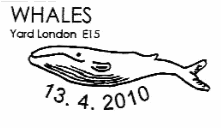
Ref L11695
Whales Yard, London E 15 |
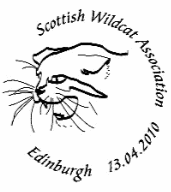
Ref S11701
Scottish
Wildcat Association Edinburgh |
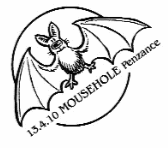
Ref W11704
Mousehole, Penzance (Cornwall) |
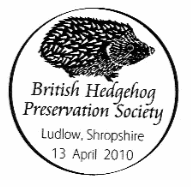
Ref W11705 British
Hedgehog Preservation Society,
Ludlow, Shropshire |
 |
 |
 |
|
|
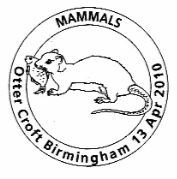
Ref
M11698
Otter Croft, Birmingham |
Ref
L11691
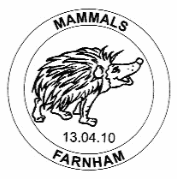
Mammals, Farnham |
Ref
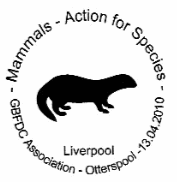
N11699 Otterspool, Liverpool (GBFDC Assoc) |
|
|
If
you would like to be contacted when this page is updated please use the
ChangeDetection panel alongside the stamp
image; any other enquires please email
us.
NB:
emails will usually be acknowledged in 1-2 days. If you do not receive
an acknowledgement please email us from a different address (eg
hotmail, gmail).
This page updated 4 June
2010
Instant Printing Prices
from Webmart